

Kate Chopin: In Her Own Words
"Even as a child she had lived her own small life all within herself. At a very early period she had apprehended instinctively the dual life—that outward existence which conforms, the inward life which questions." Description of Edna Pontellier in The Awakening.
"She wanted to reach out her hand in the darkness and touch him with the sensitive tips of her fingers upon the face or the lips. She wanted to draw close to him and whisper against his cheek—she did not care what—as she might have done if she had not been a respectable woman." Description of Mrs. Baroda in "A Respectable Woman."
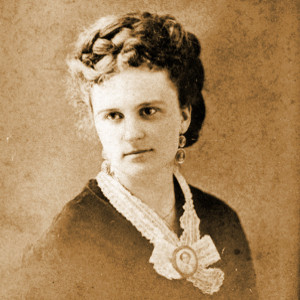
American author Kate Chopin (1850–1904) wrote about a hundred short stories and two novels in the 1890s. Most of her fiction is set in Louisiana and most of her best-known work focuses on the lives of sensitive, intelligent women.
Her short stories were well received in her own time (continue)
| |
"There would be no one to live for her during those coming years; she would live for herself. There would be no powerful will bending hers in that blind persistence with which men and women believe they have a right to impose a private will upon a fellow-creature." Description of Mrs. Mallard in "The Story of an Hour."
"There was the hum of bees and the musky odor of pinks filled the air." The closing sentence of The Awakening.
"As she glanced up at him the fear in her liquid blue eyes had given place to a drowsy gleam that unconsciously betrayed a sensuous desire." Description of Calixta in "The Storm."
"I dance with people I despise; amuse myself with men whose only talent lies in their feet, gain the disapprobation of people I honor and respect; return home at day break with my brain in a state which was never intended for it; and arise in the middle of the next day feeling infinitely more, in spirit and flesh like a Liliputian, than a woman with body and soul." Entry (when she was eighteen) in her Commonplace Book, 1868-1869
"If ever asked to give her opinion of divorce, she might have replied that the question being one which did not immediately concern her, its remoteness had removed it from the range of her inquiry. . . . With the prejudices of her Catholic education coloring her sentiment, she instinctively shrank when the theme confronted her as one having even a remote reference to her own clean existence." Description of Thérèse Lafirme in At Fault, Kate Chopin's early novel.
" 'It means,' he answered lightly, 'that the child is not white; it means that you are not white.' " Armand Aubigny in "Désirée's Baby."
"She was not going through any acute mental process or reasoning with herself, nor was she striving to explain to her satisfaction the motive of her action. She was not thinking at all. She seemed for the time to be taking a rest from that laborious and fatiguing function and to have abandoned herself to some mechanical impulse that directed her actions and freed her of responsibility." Description of Mrs. Sommers in "A Pair of Silk Stockings."
"When the girl looked up into her face, with murmured thanks, Fedora bent down and pressed a long, penetrating kiss upon her mouth." Description of Fedora in "Fedora."
The photographs: Kate O'Flaherty Chopin (Missouri Historical Society, St. Louis); the house in St. Louis where Kate O'Flaherty met the man who would become her husband; and pinks—the flowers mentioned in the closing sentence of The Awakening.
| |
"He would keep clear of the maelstroms of sordid work and senseless pleasure in which the average American businessman may be said alternately to exist, and which reduce him, naturally, to a rather ragged condition of soul." Description of Wallace Offdean in "A No-Account Creole," one of Chopin's earliest short stories.
"I would give up the unessential; I would give my money, I would give my life for my children; but I wouldn’t give myself." Edna Pontellier in The Awakening.
"That she was married made no particle of difference to Gouvernail. He could not conceive or dream of it making a difference. When the time came that she wanted him,—as he hoped and believed it would come,—he felt he would have a right to her. So long as she did not want him, he had no right to her,—no more than her husband had." From "Athénaïse."
About the Kate Chopin International Society
About this web site
|